Sunday, September 25, 2011

Italy (Siena)

Duomo in Orvieto
Siena is a small, medieval town north of Rome in Tuscany.  On our trip to Siena we made a two hour stop in the small hilltop town of Orvieto.  Orvieto is home to a beautiful duomo in the center of town.  We were able to enjoy views from our elevated vantage.  After walking around the narrow streets and enjoying some gelato we boarded our bus for our final journey with Busabout.


Marilyn on the Orvieto town wall


The Siena Duomo, similar to Orvieto wouldn't you say?
We arrived in Siena, excited to be staying in such a picturesque town that was everything you'd picture an Italian town to be.  There are a few main sights in this small town, Piazza del Campo and a duomo.  Piazza del Campo is the main square in town with a large bell tower offering views of the town.  This square is actually a semicircle that slants down resembling a shallow stadium.  It is famous for the annual horse race, Palio de Siena, which takes place in mid-August.  Unfortunately we just missed it.  The race is between the neighborhoods of Siena and is taken very seriously, giving the winner much in the way of bragging rights.  The duomo has black and white patterned stone work on the outside that gives it a beautiful appearance.  It is most known for the marble work on the floor inside the church, depicting pictures along the main aisle.


Piazza del Campo at night


Drummers and flag bearers who were parading around the streets for hours.  This had something to do with the recent horse race, but we couldn't quite figure out what exactly.


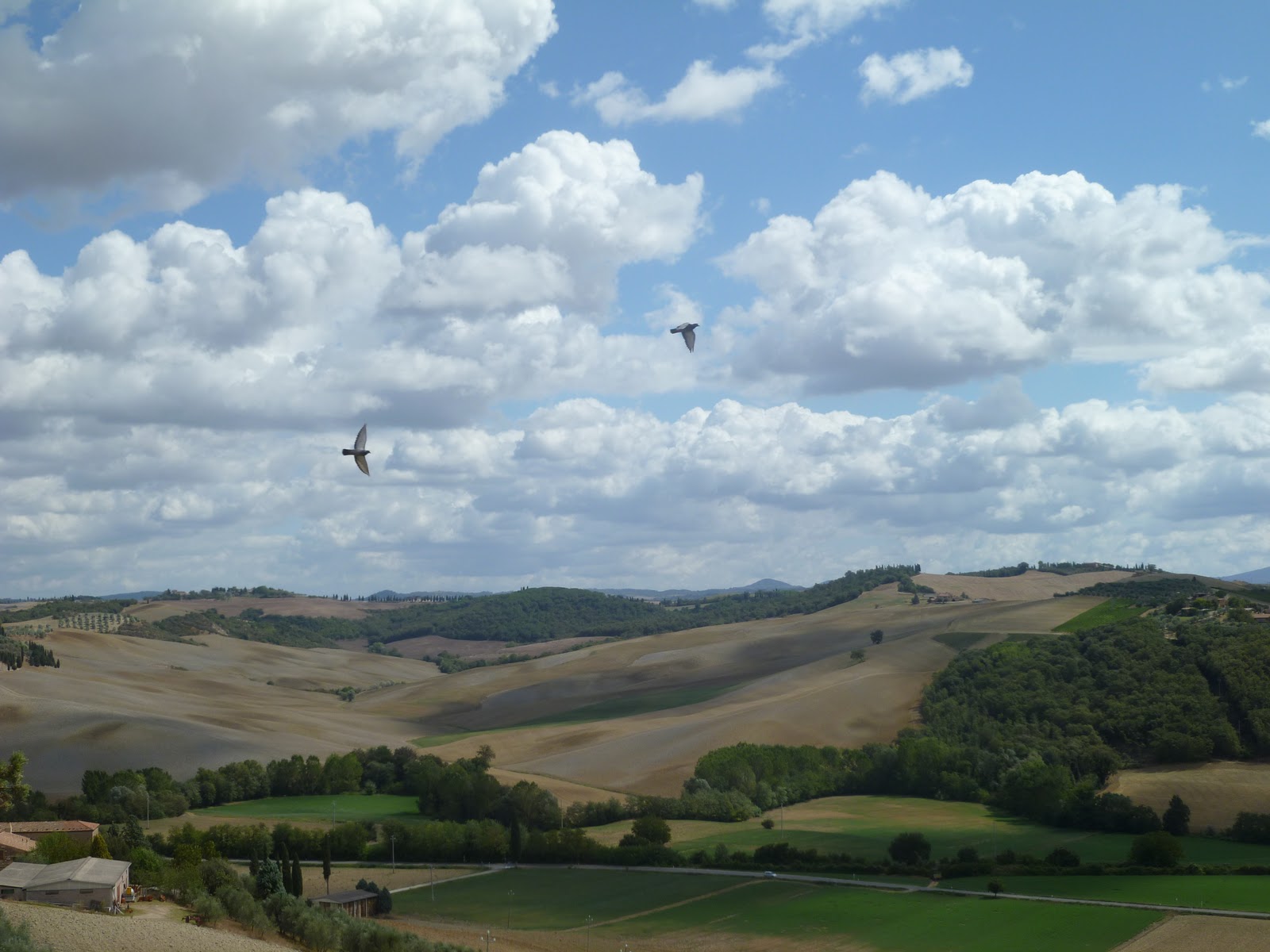
Much of the appeal of Siena is in walking down the pedestrian streets, catching glimpses of serene alleyways and views of far off mountains. There are numerous places in town that offer amazing vantage points.  We actually lucked out, having a wonderful view from our room in our bed and breakfast.  It looked down a street onto San Domenico Basilica and to the mountains off in the distance.


Veiw of Siena from below


San Domenico at dusk


San Domenico is known for housing relics of Saint Catherine.  They boast of having her head and thumb.  We did not see her thumb; however her head was on full display. At first glance it seems that it is just a picture or model of her, however on closer examination we were able to see that it was indeed her skull wearing a habit.  We were both quite shocked by this and pondered the various ways they may have acquired this.  There was a sign informing us that this was not just an ordinary 'head', but this had been officially verified as her head.  We were quite relieved to know that we were not looking at some unimportant person’s skull.


Saint Catherine's head!!


We often look to Tripadvisor for advice on things to do, as you may know. The top item in Siena was the Tuscany Wine School where you could take a 2 hour course, sampling half a dozen wines, enjoying snacks, and learning about wine native to Italy, more specifically the Tuscan region.  We decided it was something we both really wanted to do and ended up being one of our highlights from this trip. We had a great time learning everything from how to properly taste wine to the government regulations on Italian wine.  More importantly, we realized that we had only scratched the surface of what there is to know.  The variety of offered wines was delicious, by far the best that we have had on our trip.


Our wine classroom


Since Siena was our last stop in Italy we decided to take full advantage of all the delicious food.  We enjoyed two delicious dinners that had been recommended in our guide book.  Our last meal was incredible.  Matt got handmade pasta stuffed with meat in a gorgonzola sauce and Marilyn got a dish of pici with mushrooms and a delicious sauce.  We then split a dish of tender veal with white beans covered in a delicious sauce.  It is hard to describe the wonderful meal; however it could not go unmentioned!


The two of us walking around before dinner


The scooter
Our final day in Siena could possibly be our favorite day from the entire trip.  We rented a Vespa scooter early in the morning and spent the day scooting around the Tuscan countryside.  It was truly breathtaking.  Matt handled the Vespa like a pro (after almost hitting a pedestrian) while Marilyn held on for dear life, risking it all to document the trip.  We traveled through small towns, taking frequent stops to capture the scenery. We luckily chose a path that wound beautifully through farm fields, vineyards and olive groves.  We made our final stop in Montalcino, a spectacular town perched high on a hill, known for its high quality Brunello wine.  We ate sandwiches from the local deli on the edge of a vineyard, overlooking miles of uninterrupted rolling hills.  Our ride back was just as beautiful, however we were disappointed to exchange the freedom the Vespa gave us for our heavy backpacks and a tedious 19 hour journey back to Rome and finally to Athens.  There are a lot of pictures coming up, it was too hard to just pick one or two!


View from Montalcino


Our picnic site


One of the many vineyards


Thursday, September 22, 2011

Italy (Rome)

We arrived to our hostel in Rome in the late evening and were greeted by our host Francesca.  It was more of a guesthouse, as there were only 3 rooms and a small kitchen area; a very charming little place in a nice neighborhood near the Colosseum.  Francesca was a very gracious and friendly host.  She provided us with a great map of the city, as well as several tips on places to see, eat, drink, and get groceries.  We were pretty worn out from our day of travel, so we grabbed a bite at a nearby cafĂ© and relaxed for the night.  The city of Rome occupies a hefty section of every tour book, so we knew we needed our rest for the days of sightseeing ahead.  We found a guided tour which met the next day at 5:30pm, with a highly rated and reviewed tour guide named Stephano (thanks Tripadvisor!).


The Colosseum at night


There was quite a bit of time before our tour, so we decided to walk around, get a feel for the city, and see some of the highlights ourselves.  We walked past the Colosseum, the Circus Maximus, some Roman bath ruins, the Vittorio Emmanuel Monument, the old Roman Forum, Palatine Hill, Trevi Fountain, some more ruins, and finally ended at the Spanish Steps where our tour met.  The Vittorio Emmanuel monument celebrates Italy’s unification and independence, which was gained back in 1861, making this year the 150th anniversary.  It housed a museum which detailed the years and events leading up to the unification.  It struck us as a very turbulent effort, with several failed attempts before eventual success.  Even after unification, Rome was not part of Italy until a few years later.  It was not until after a siege of the city that the Pope gave up his temporal powers and Rome became the rightful capital of a united Italy.


Marilyn in front of the Vittorio Emanuele Monument at night

Ruins in the old Roman Forum


A famous Bernini sculpture
Anyway, we met Stephano as planned and set out on our tour.  He was a short, older Italian man, who was very animated and passionate about his city.  We learned about Pope Urban, who was very instrumental in Roman city works.  His mark, the bumblebee (an insect that he was particularly enamored with), was evident in several fountains, buildings, and even on the lone restored pillar of the Pantheon.  The Pantheon was probably the most impressive sight that we saw; a 2000 year old domed structure which has deteriorated only slightly through the years.  The dome was the largest in the world until the New Orleans Superdome was built, and if constructed with modern concrete and construction methods, would have crumbled long ago.  Stephano also took us in to a few beautiful churches, including one with two famous sculptures by Bernini.  It was a great tour, but an exhausting day.  We decided to replenish our energy by eating at one of the restaurants Francesca had recommended.  It turned out to be a great pasta meal, and we were thankful that we had saved our money so we could eat out more in Italy.


The Pantheon


Our dinner!


We dedicated the next day for seeing the Vatican.  No trip to Rome would be complete without it.  As you may know, the Vatican is actually its own sovereign nation, .44 sq. km of walled land plopped down in central Rome.  We elected to see the Vatican museums first, which includes the Sistine Chapel.  We’re not experts, but this has to be one of the most impressive museums in the world.  There are rooms filled with ancient sculptures, many more than 2000 years old.  Pottery from the Etruscan people before the Roman Empire.  Paintings by all the famous Renaissance men, Michelangelo, Raphael, Leonardo da Vinci, etc, etc.  Each piece we saw was another priceless work of art.  We found out that this amazing collection was put together after a mandate by the Catholic Church in the 17 and 1800s to collect and preserve important works of art.  The last stop was the Sistine Chapel, whose entire ceiling is famously painted by Michelangelo.  As if this wasn’t impressive enough, we obviously had to see St. Peter’s Basilica.  This enormous cathedral is like no other, and really can’t be compared to any church, cathedral, or duomo we have seen.  It also houses Michelangelo’s Pieta, easy to spot because of the crowds of people angling to get a good picture.  It is the only work that Michelangelo ever signed.  It was another full day, but we weren’t done yet!


If I remember, this is what remains of a Greek statue, made a few hundred years B.C.


The famous Michelangelo statue in St. Peter's Basilica


The roof of the Sistine Chapel


Marilyn in St. Peter's Basilica


The front facade of St. Peter's Basilica.  Hard to appreciate from just a picture!


Next on the list was the Colosseum.  Armed with some good info (again from Tripadvisor!) we were able to skip the probably hour+ line and get our tickets within 5 minutes.  For anyone who plans to visit, you can do this in one of two ways.  First, you can go to the Palatine Hill/Roman Forum first and buy your ticket there; this is a combined ticket with the Colosseum, the same one you would get at the Colosseum.  Alternatively, if you look for the signs pointing to the audio tour at the Colosseum, you can skip right past everyone, and buy your ticket at the same time as the audio tour, which, like I said, is only about a 5 minute line!  Anyway, this was another amazing feat of Roman engineering which has stood the test of time.  Standing there and imagining how 50,000+ people watched the bloody games 2000 years ago is very surreal.  It is truly amazing how advanced the Romans were.  They had organized ticket systems for spectators, bathrooms, and even stoves and ovens for re-heating or preparing food.  Modern stadiums are so clearly influenced by this early structure.


The Colosseum with some other ruins in the foreground


Inside of the Colosseum.  The small amount of wood floor shown is a recreation


We spent the rest of the afternoon exploring the many ruins of the Palatine Hill and Roman Forum area.  Though much less well preserved, these areas are still very impressive.  Historians have created virtual reconstructions based on research and excavations.  What a truly amazing area this must have been.  Afterward, we headed over to the San Clemente Basilica.  This is nice, church, but nothing too special.  The real draw lies below the surface.  Literally.  Descending the staircase you find yourself in a 4th century church.  There are still pillars intact and remnants on the walls.  From there you can take another staircase down and discover a 1st century pagan temple.  The altar and various rooms have been preserved.  This was quite remarkable and unique to this area.  The river that flows through Rome used to regularly flood before dams were built.  Therefore, over the years the flooding added layers of sediment, covering and protecting these places of worship.  


The stairs down to the 4th century church


A room from the 1st century temple


Rome did a good job of wiping us out, but we still have one more stop in Italy... Siena.


Tuesday, September 6, 2011

Italy (Venice)

On our way from Munich to Venice, the Busabout coach made an optional stop at Innsbruck, Austria.  Although we weren’t staying there, everyone was allowed about an hour to get out, look around the town, and maybe grab a bite to eat.  Innsbruck is a beautiful town, situated at the foot of the towering Alps, and is known as a skiing mecca.  We had the chance to take a few pictures (about 57, approximately one per minute…a new best for Marilyn) and eat the sandwiches we packed before we hopped back on the bus.  The next few hours driving through Austria and Northern Italy were absolutely incredible.  We wound through the mountains, with hilltop castles, vineyards, and lemon groves becoming commonplace along our route.

The profile picture


The bus dropped us on the mainland at a youth campsite, about a 40 minute bus ride from the main Venice Island.  Since we wanted to experience the city, and not have to trek back and forth every day, we elected to stay at a rented apartment near the downtown area.  We hopped the bus, and since we were unfamiliar with the vaporettos (Venice’s boat public transportation) we figured it would be best to just walk to our apartment.  This may have not been the best idea, as when we finally arrived, we were drenched in sweat from carrying our bags 45 minutes in 90+ degree heat.


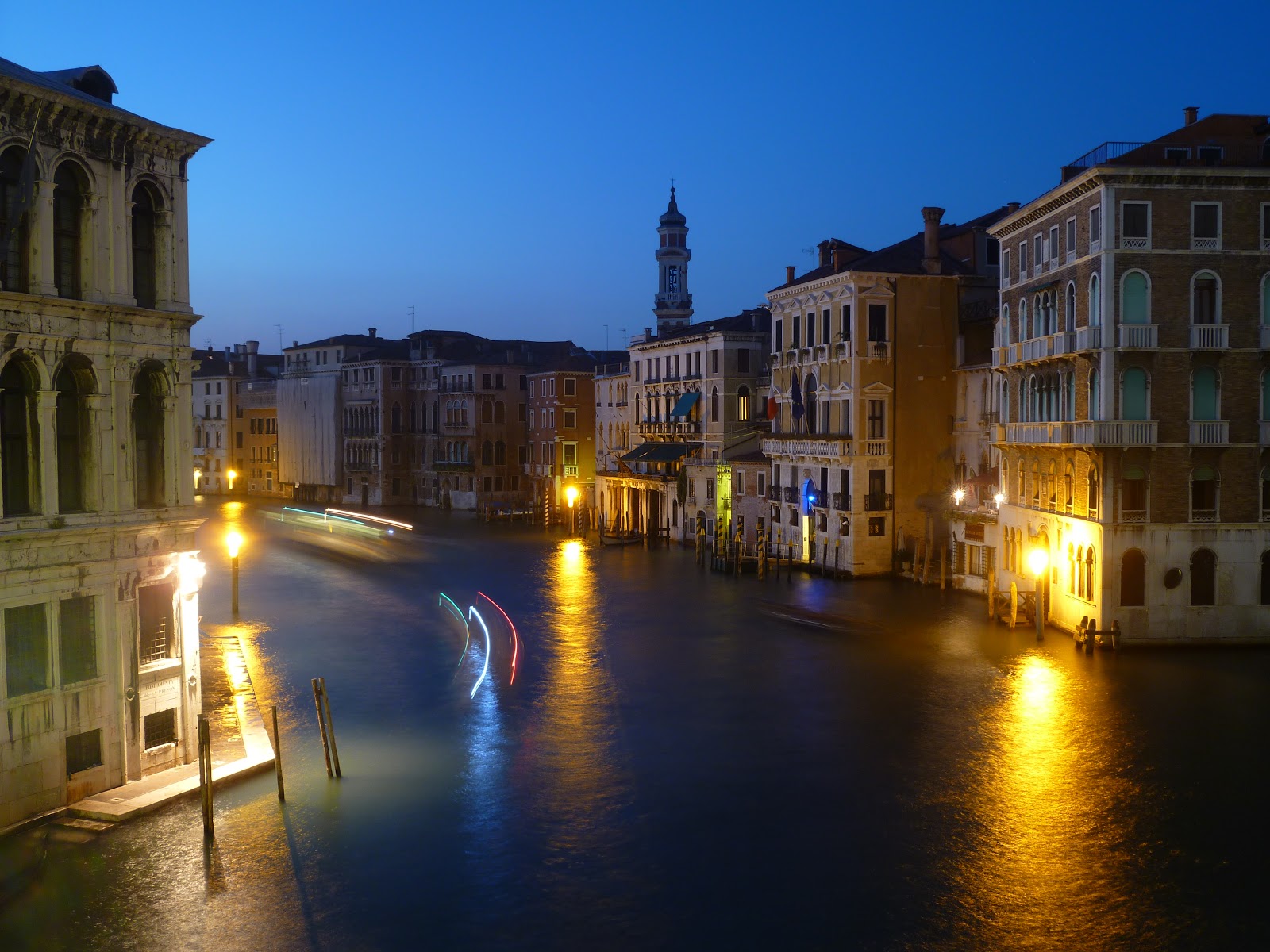
Bags finally dropped, and showers taken, we could then start to appreciate Venice.  The city is truly unique in many ways.  All the streets are completely pedestrian; there are no cars or even scooters.  The buildings are crammed in together, making some ‘regular’ roads so narrow you can’t even walk side by side.  The numerous canals are populated by small dinghies, large passenger bus-boats (the vaporettos), police cruisers, cargo boats, and of course gondolas.  If you aren’t walking, you are in some kind of boat.  The Grand Canal is the largest which runs through the center of the island, and is where the vaporetto routes run.  The vaporettos are quite amazing.  They have bus stops like you would find on any city street, however they are floating and you get picked up by a boat.  These boats are actually a pretty great way to see the city, not that we are alone in this thought because they are often filled with tourists, cameras in hand.


The vaporetto is the large boat on the left


The architecture of the city is grand, impressive, and somewhat dilapidated.  The dilapidation did not take away from the beauty, but rather added to it.  We both noticed this almost immediately, and actually happened on the technical term while reading the Wikipedia page for Venice.  Venice is said to be in ‘elegant decay’, a concept that being in disrepair and threatened by rising tides and sinking foundations actually adds to its beauty and allure.  A little hard to explain, but easy to see when you are there.

The grand canal


People on a gondola ride


The main attraction in Venice is San Marco Square.  This is one of the few large, open areas in the city, and is where the Doge’s Palace, bell tower, and San Marco’s Basilica are.  We were excited to check out these attractions, as the outer facades were very beautiful.  However, Venice gets about 20 million tourists a year, and so as you would expect, the main attractions are completely overrun in the high season.  The basilica opened at 9:45am, and already at 9, there was a line 100 yards long.  We both decided that waiting two hours to see another church, just simply wasn’t worth it.  Content to see the outside of these buildings, we decided we enjoyed getting lost in more remote and less crowded streets.


San Marco Square


The heat wave continued, so after a full day exploring the city, we decided it was time to seek out some swimming, Venice is technically on the ocean after all.  We found out that there were lots of public beaches at a nearby island called Lido, so we made our way over there.  It wasn’t the best beach in the world, but cooling down in the ocean for a few hours was a much needed respite from the heat.


Venice is also famous for its glass blowing industry.  The authentic glass is made at another nearby island, Murano.  We were able to see some factories where they offer demonstrations of the glass blowing; however we happened to be there during the traditional ‘siesta.’  As we looked through shops we were excited to see some very inexpensive pieces.  This seemed too good to be true and like most things it was.  We discovered that many shops were selling items most likely from China (not that we have anything against China) and did not go out of their way to tell this to the costumer.  So if you are ever in Murano make sure you get a card of authenticity or go to a shop that guarantees glass made locally in Murano.


Murano


Before arriving in Venice we had been warned that everyone tries to take advantage of tourists (charging outrageous amounts for coffee for example).  Therefore, our first two days we avoided buying food out, making our meals in our apartment.  However, after walking by numerous restaurants exuding delicious aromas we could not wait any more.  We found that there are many reasonably priced restaurants.  If you want to be a stupid tourist who only dines in the main square, then yes you will pay an arm and a leg, however if you put any effort into it at all you will find great food for much less.  We were fortunate that Marilyn’s father had recently put extra money in her account to enjoy a meal on him.  Well, we certainly did.  Our first meal in Italy was a success!  We started out with melon wrapped in prosciutto and then each enjoyed an entree.  Matt had swordfish while Marilyn had (the most delicious) dish of pasta with scallops and mushrooms.  Of course you cannot eat in Italy without a bottle of red wine.  Boy oh boy, this was worth the wait!


Our dinner!


The grand canal at night


We enjoyed out last day in Venice getting lost in the narrow streets and getting caught up in the beautiful views.  It was a great start to our tour of Italy.  Next to Roma…

Saturday, August 27, 2011

Germany (Munich)


Arriving in Munich had different anticipation than our previous cities.  We had family waiting for us!  When we showed up at our hotel Marilyn’s mom and brother Danny were awaiting our arrival.  As wonderful as all this time has been for the two of us, we were excited to see some familiar faces.  We didn’t want to waste any time, so we began our reunion at the Chinesischer Turm, a beer garden in the Englischer Park.  The Bavarian region is known for their beer gardens and beer halls (beer gardens you can bring your own food, not the case for beer halls).  We spent the night trying to catch up as best we could over large pretzels, sausage, and delicious German beer.  We could not have asked for a better return to Germany.


Danny and Judi had rented a car for the first few days, so the following morning we piled into the car and headed on the southern route of the ‘Romantic Road’ toward the Bavarian Alps.  The Romantic Road term was coined after WWII as Germany tried to revitalize its tourism industry.  It follows a series of picturesque towns through the beautiful Bavarian countryside.  Our first destination was Fussen, a city near the Austrian border where King Ludwig II had built a fairytale castle for himself.  His main advisor when undertaking the project was not an architect, but a play set designer.  It was a job well done because Disney actually copied it (as can be seen in Orlando).  As he also drained the royal coffers in the process, it is no surprise that he was deemed insane and forced to abdicate the throne.  Ludwig knew what he was doing though, as the huge number of tourists and high ticket prices suggested that the coffers have been refilled many times over.  Nearby was a more modest castle, the one that Ludwig lived in as a child (the one just wasn’t enough).  From the castles we continued driving down along the Alps, giving us fantastic views along the way.


The Fairytale Castle


The 'Other' Castle


The next and final day with the car we took the northern route of the Romantic Road, visiting three medieval towns.  Our first stop was Harburg, known for its castle.  This was quite different from the castles we had seen the previous day.  There were very few tourists and all the tours were in German, clearly catering to different audience.  This medieval castle was meant for defense, standing on a hill with high walls and was certainly not constructed by a set designer.  From there we went to Dinklesbuhl and Rothenberg ob der Tauber, two picturesque towns with lots of medieval architecture.


Harburg Castle


Rothenberg Town Square


Since we no longer had the car, and we were staying there we decided it might be a good idea to actually see the city of Munich.  We used our familiar walking tour as a way of getting to know the city.  We started in the center of the city, Marienplatz, known for its City Hall that houses the famous Glockenspiel, a musical bell show with moving models.  It was made clear to us by our tour guide that beer plays an important role in Munich’s history and modern life.  This city is probably most known for Oktoberfest where Munich’s population goes from 1.5 to 7.5 million.  People flood the streets and drink from the local breweries for a two week festival.  Beer gardens and beer halls are scattered all around the city, always filled with all types of people imaginable, drinking from 1L mugs. 


Munich Town Hall where the Glockenspiel is housed


Munich Cathedral


The beer! (and Dan)


Munich hasn’t always been so fun and lighthearted however.  Hitler nearly came to power even sooner here in the 1920s, when he staged an unsuccessful coup.  Munich proved to be his area of strongest support when he later took power with the Nazi party in the 1930s through a democratic vote.  It was also the beginning of the infamous Jewish pogrom, called Kristallnacht, where SS men began race riots in the streets, destroying Jewish property and synagogues.  About 20 minutes away by train was the first Nazi concentration camp in Dachau which we visited the next day.


Site where Hitler delivered many of his speeches in Munich


Dachau was in operation for the entire duration of the Third Reich, from 1933-1945.  In the first few years of operation it might have been considered tame as far as concentration camps go, mainly imprisoning political rivals of the Nazi party.  However as time went on and violence increased it became much more horrifying and bloody.  We knew that we wanted to visit a concentration camp during our time in Germany; however it was not an experience we would say that we enjoyed.  It was very powerful walking the grounds and learning the more specific history of what went on there.


Dachau wall and fence


Since this was our last day together we tried to cram in as much as possible.  After the draining tour at Dachau we returned to Munich to explore the Residenz, the royal palace.  This “house” was very impressive and overwhelming.  Each room was an incredible piece of art; however it became exhausting after a while due to the sheer number of rooms.  We were officially wiped after this day, however disappointed to see it end because we knew we would have to say goodbye.  


A Residenz Dining Room


After Judi and Danny left, we had a few more days to look around Munich.  We decided to check out the Duetsches Museum, a science and technology museum.  One of us was clearly more excited and engaged while the other had to take frequent breaks (hmm who could that be?).  Marilyn did admit however that this was an amazing museum.  It had information and exhibits on everything you could think of, from aviation, to computers, to machine tools, to pharmaceuticals…. etc.  Our two favorite were the marine transport and aviation exhibits.  The marine transport area had extremely detailed models of different types of ships and boats as they appeared throughout history.  In addition they had some full size boats which had been cross-sectioned for viewing.  The same was true in the aviation section, except with planes and jet engines.  They even had a full size replica of the Wright brothers’ plane hanging from the ceiling!


Life size original and replica early flying machines


A scale model of an 1800s clipper ship


On our last day we decided to take the S-Bahn out to Freising, where Matt’s favorite brewery, Weihenstephaner, is located.  It is the oldest brewery in the world, dating back to 1040.  We hoped that we could get a tour, but were doubtful as it wasn’t a huge tourist attraction.  Unfortunately, this did prove to be the case; asking the receptionist about a tour elicited the simple response, ‘nein’.  Even though our tour did not work out, we had lunch there as the brewery grounds had several beautiful gardens and great views of the countryside from its hilltop vantage.  Another unexpected gem was the Freising Dom.  We could tell that some kind of church complex was perched on top of another hill in town and decided to explore.  Once we got up to the main courtyard we were presented with a large but seemingly plain cathedral.  The inside proved to be quite the opposite though, we both agreed it was the most impressive we have seen yet.  And if you’ve been following our blog, you know that we have seen our fair share of churches.  The inside of the church was beautifully decorated with paintings, but it was the dark basement chapel, filled with various relics and tombs that added to the allure.


Entrance to the brewery


Interior of the Freising Cathedral


We are currently on our way to Venice.  We have been saving up our pennies to splurge on our favorite food.  And it looks as though this is the end of our beer blog, bring on the vino!